Showing posts with label Film. Show all posts

Friday, 12 November 2010

Another Year


Mike Leigh's last venture, Happy Go Lucky, had the potential to be one of his best yet; a fantastic performance from Eddie Marsan and a clever, thoughtful concept. The experience was ruined, however, by a ceaseless onslaught of jitteriness from Sally Hawkins in her role as the wildly irritating Poppy; but that's another story for another time. For the record, I am told that she's much better in Made in Dagenham, but I digress; my point for today is that Another Year - the latest addition to the Mike Leigh showreel - is a magnificent return to form. The Oscar-tipped ensemble piece was constructed using Leigh's usual drama school devising techniques and takes the film-where-nothing-happens concept to fantastic and moving new heights. Somehow managing to cram an impossible level of involvement and character depth into a plot that doesn't exist, it becomes the mind-boggling cinematic equivalent of a print by M.C. Escher.

I genuinely loved it and it lived up to all the hype. Heavily character-driven, the trailer sets it up as centering around an elderly couple named - wait for it - Tom and Gerri. They themselves are thoroughly content with their lives, their careers, and their relationship, which draws their various unstable acquaintances towards them as the voices of reason - the manner that Gerri has acquired within her job as a therapist certainly doesn't drive them away. They console and advise the damaged souls that pass through their house night after night. It soon becomes clear though, that the real focal cast member is recurrent soldier in the Leigh brigade, Lesley Manville, in the role of the lonely, partnerless Mary. Like a darker Bridget Jones, she tries to put on an entirely transparent brave face after two divorces and the increasing prospect of growing old alone. Manville's use of subtle facial and vocal nuance is compelling and involving, and the script manages to hauntingly reveal her hardships without actually showing any of them.

The narrative pace is, as always, unhurried. It takes slow, considered steps across the minefield of complexity within the characters' relationships, without ever losing the power to hold its audience in full attention. There is also no real resolution but instead a full-circle sense of the continuing happy/unhappy balance. Tom and Gerri's son, Joe, embarks on what seems like an equally contented relationship with his new girlfriend, while Mary is sent into therapy where an older, similarly depressed woman - played by Imelda Staunton - began in the opening scene. I would argue that this harsh, life-goes-on sentiment is the realisation that Tom and Gerri themselves come to towards the end of the film. They move slowly from their sympathetic humouring of Mary and her problems, into a more tough love approach whereby they force her to confront her issues and quell her dependence on their family.

I won't linger on the leading couple, it has been suggested that they can be seen as everything from well-mannered and lovable to smug and self satisfied. It is interpretable in myriad ways, and therein lies the beauty of this film. It is an intimate, considerate portrayal of dysfunction, presented with an ambiguity and a lack of finality that left me reeling at the end.

Saturday, 14 August 2010

Inception


Inception marks an important reference point in the long-fought debate surrounding special effects and artistic credibility in the high budget blockbuster. A shining example of a budget put to good use, Christopher Nolan further proves that mainstream distribution and success are not synonymous with artless crowd-pleasing. CGI has been minimised where possible in the production of this film, Nolan as usual choosing instead to foreground stunts and pump money into on-camera special effects. An ideal example of this is a fight scene in a revolving corridor, all of which was filmed for real in a 35-metre long tunnel spinning at six revs per minute. It is unalienating; unjarring. Plush, surreal environments are beautifully and expertly conjured without the contrived, distant feel produced by CGI overuse.

Plot is something which cannot be overlooked in any discussion of Inception as a movie, the premise is inspirational. In a world where one's dreams can be infiltrated, a group of contract thieves are paid to "extract" important information from the oblivious, sleeping minds of their victims. However, when they are asked instead to plant an idea in their mark's mind, an elaborate scheme must be developed to reach the deepest corners of a man's subconscious. Dom Cobb (Leonardo DiCaprio) and his team must enter a dream within a dream within a dream in order to plant a seed that will soon reach up to the surface. Nolan's intelligent, (quite literally) layered narrative provides weeks of discussion (for which this is not the arena), while still remaining followable with countless visual signifiers to maintain audience comprehension. For instance the complexities of time comparison across the various planes of reality are clearly defined through tasteful slow motion and an insightful avoidance of overcomplication in editing. At no point do the many worlds become overwhelming.


It is also a testament to Nolan as a writer that among all this entanglement and intricacy, a gripping depth of character is maintained without convolution. While other characters are not explored quite as thoroughly as DiCaprio's, his impressively complex profile is an unmissable opportunity for any actor talented enough to materialise the role. And DiCaprio, as usual, certainly does not disappoint; his wildly intense yet understated performance could have Gary Cooper on the edge of his seat, and the worsening state of his tortured psyche is conveyed with utter realism. Acting is in fact notably accomplished on almost all counts: Ellen Page is solid in the role of Ariadne as she unpicks Cobb's increasingly troubled mind with an unassuming maturity and intelligence; the uncertainty and vulnerability emanating from Robert Fischer (Cillian Murphy), the team's mark and grieving heir to an empire warrants genuine sympathy even for a relatively functional role; also hugely likeable are Eaves (Tom Hardy) and Arthur (Joseph Gordon-Levitt), whose brotherly rivalry is sharply written, sharply acted, and even more sharply dressed.

The film as a whole represents an elegant artistry in writing, direction and cinematography without sacrificing warmth and character. It takes the age old theme of crisis of reality as addressed in films like The Matrix and Shutter Island, but rethinks it from a multitude of new angles simultaneously, resulting in a masterful intricacy worthy of a second cinema watch at the very least.

Thursday, 12 August 2010

Gainsbourg (Vie Héroïque)


The newest in the current wave of French language biopics, 'Gainsbourg (Vie Héroïque)' details the self-destructive adventures of 60's/70's Enfant Terrible, Serge Gainsbourg. The opening shot is of a young, pre-moniker Lucien Ginsburg (Kacey Mottet-Klein) on a beach, smoking a cigarette while propositioning a girl, and Joann Sfar's ambitious directorial debut begins as it means to go on. Aside from various interjections of narrative the film, for the most part, functions as a 130-minute extension of that moment. This is not necessarily a criticism however; stylistically it is suave, inventive and sexy, and I have never before been left feeling so libidinous and enticed by nicotine in such equally generous measures. The film is weakened though to an extent by a certain lack of substance, sacrificed as it is in favour of beautiful women, billowing smoke and anecdotal accuracy.

The strong first half of the film sets up the surreal element to Sfar's auteurship in the form of Gainsbourg's "gueule" - or "mug" in the English subtitles - an unsettling apparition who represents a troubled inner psyche. While Mottet-Klein plays the defiant and brazen young Jewish child in wartime France, this gueule appears as an enormous floating Jew's head, following him and risking his discovery by the Nazis. Lucien uses his skills as a painter to distract himself from feeling like an outsider as he queues to pick up his compulsory Star of David badge and fantasises about women three times his age. Later though, as the fully grown Gainsbourg (Eric Elmosnino) becomes more confident in his abilities both in music and seduction, this gueule reappears as a tall, stylishly vampiric marionette, not unlike 'The Count' from sesame street. The gueule by this point functions as an alter ego named "Gainsbarre"; the devil on Gainsbourg's shoulder, driving the self-destructive behaviour against which he is battling. Elmosnino's performance of this inner battle is quite fantastic; emphasised by an uncanny likeness to his real life counterpart, the transition from a talented but uncertain bar pianist to the suave yet abrasive, walking death-wish he becomes by the end of the film is very impressive. He is not done any great favours however, by Sfar's insistence on total biographical inclusion. The film flows as a series of fleeting, seemingly disconnected encounters with various people, making it difficult to cover anything in depth. Arguably each encounter bears some significance to Gainsburg's development as a character, but this development may have been explored more effectively through a merging of certain characters at the sacrifice of historical accuracy.

When push comes to shove, the film is largely enjoyable; visually Sfar has taken a lot of care in getting it exactly as he wanted and it's certainly worth seeing. The casting is notably excellent, particularly with regard to the array of entrancing beauties flitting about in various stages of undress. The soundtrack, too, is well incorporated and scenes like Gainsbourg and Boris Vian's (Phillipe Katerine) duet of "Je Bois" leave you ready to sell a kidney just to be as cool as them. Unfortunately though, as the plot develops, the lack of character exploration makes the increasingly haggard protagonist seem somewhat one-dimensional as he spirals into alcoholism and maltreatment of his wife. By the end it is harder to empathise with Gainsbourg, and the character depth achieved early on becomes lost to a degree behind an ever-darkening cloud of cigarette smoke.

Wednesday, 18 November 2009

Fantastic Mr. Fox

Wes Anderson's defiant and simplistic adaptation of this classic Roald Dahl tale about a wily fox and his chicken-stealing exploits is as clever, neurotic and strangely moving as any Royal Tenenbaums or Darjeeling Limited fan would expect. Amidst a filmic landscape crowded with super high-quality, three-dimensional children's CGI movies, Anderson's first feature length animation presents us with an adorably old school stop-motion similar to that of Michel Gondry's The Science of Sleep. The wiry, bristling fox fur makes no latest-technology promises, but instead provides a simple charm and character that no computer-generated Pixar flick could offer.

Mr. Fox (George Clooney) and his family display all the endearingly dysfunctional qualities I've come to love in Anderson's films, and this is key to the expansions on the book that have been made. Mr. Fox, an overbearing father figure, struggles to connect with his self-loathing son, Ash (Jason Schwarzman), who wants so desperately to be athletic but seems to fall at every hurdle. The situation is made worse by the arrival of Kristofferson (Eric Anderson), a distant cousin who proves to be a natural sportsman, martial artist and ladies' man, stealing precious, parental attention away from Ash. Mr. Fox recruits Kristofferson, along with several other animals of the community - all of whom are either given more attention than in the book, or until the film had not even existed - to help him outsmart the gruesome local farmers, Boggis, Bunce and Bean. All this is sighed over by Mr. Fox's disapproving wife (Meryl Streep), who - after a near-death experience during her last chicken theft - is at her wit's end.


Those offended by the Americanisation of British classics may want to tread carefully, since the good guys in this film are exclusively American and the evil farmers all have distinctive British accents. I didn't read this as a demonisation of the English though; the world above ground where the humans live is clearly an Olde Englishe setting, but the animals all go to an American high school and play a game very similar to baseball. I think this is to distinguish some kind of binary between the humans and the animals, staying true to the English backdrop of the book, but establishing a kind of otherworldliness in the animal community. This is taken further as Anderson effortlessly tosses the animals between serious, human emotion and base, animal behaviour as Mr. Fox, a newspaper columnist with an array of autumnal-toned suits devours his breakfast in under ten seconds, leaving shards of toast scattered across the table. This struggle between human and animal within Mr. Fox represents a greater struggle between human and animal in the world of the film. It also serves as an excellent platform for Anderson to show off his capacity for both sophisticated depth of character development and sharp, knowing wit.

To an adult filmgoer Anderson's adaptation strikes a beautiful balance between inventive, nostalgic visuals; smart, indie humour; and heartwarming, family narrative. However, while its kooky charm does translate well into the realm of children's films, the intentionally static qualities of the dialogue and low-tech animation may prove wasted on children accustomed to today's action-packed, attention-holding supermovies. I hope this isn't the case but it is a risk Anderson has taken; not that it will matter though, this is a movie destined to find a wide adult fan base whether it reaches the kids or not.

Sunday, 9 August 2009

The Kids Don't Stand A Chance

Recently we've been seeing trailers for a number of children's films suitable for a more high brow audience. I'm getting more and more excited by the day for the release of Where The Wild Things Are; getting Spike Jonze in to direct is going to draw an older crowd, and I think those kids might struggle to get their tickets before they all sell out.
Here's a trailer and a featurette to get you hyped for the release, I wish we didn't have to wait until December.


I also can't wait for Fantastic Mr Fox. Directed by Wes Anderson and all done in stop motion, it looks sure to be as fantastic as its title character. It looks charming, sharp, very well cast, and it won't be long until its release!


Tuesday, 30 June 2009

Sigg Jones


"Sigg Jones" is a 3D animation movie by three French film students which should be coming out soon and looks incredible. The makers are really into their sneakers, and much of the film revolves around footwear. The main character gets superpowers from his pair of "Magic Dunks" - an impressive dunk/jordan/air trainer cross breed in pink and white. Aside from that, the animation looks top drawer, as this seven minute fight scene shows:


Also, Sneaker Freaker managed to get an interview which you can read here.

Monday, 4 May 2009

Shit yourself yet today?


I watched a Spanish horror film called Rec last night and it's fully, fully terrifying. It's a kind of Blair Witch style mockumentary where a local film crew follow a fire brigade for the night and find themselves locked in an apartment building for reasons which slowly become clear as the film unravels. It's been a while since a film has left me as distressed as I was last night, and they really pull out all the stops: suspense, shock, gore, creepy children and relentless psychological torment.

What's really cool though, is that - since it's all supposed to be footage for a documentary - all the clever, tension-building techniques are diegetic and automatically justified. Each time the scene changes there's a deathly silence, then a really loud, jarring noise as the film jumps; and sometimes there are "sound problems" during scarier parts, so everything you hear becomes distorted for extra discomfort. They even do a little "rewind" sequence so you can see some of the gore twice.

Apparently there's an American remake called Quarantine, but I imagine the original is better. It's like the illegitimate love child of The Blair Witch Project and 28 Days Later, with all the moral dilemma of Sophie's Choice... Alright, maybe Sophie's Choice is an overstatement, but there's some really conscience-tearing moments. It came out a couple of years ago, so go out and rent or buy it, but have some clean pants to hand.

Friday, 27 March 2009

Watchmen


Something that excited me, and sparked a lot of debate among my friends this month was the release of Alan Moore's "Watchmen" in a film adaptation directed by none other than Zack Snyder, of "300" fame. The story follows the ex-members of a disbanded vigilante group in a kind of alternate history where Nixon is in his third or fourth term of presidency (maybe even fifth, I forget) in 1985. With the exception of the atomically enhanced Doctor Manhattan, none of the Watchmen bear any discernible superpowers; we see them as everyday people, each with their own motives and struggles. Moore's frank, politically rife graphic novel takes the ordinary citizen with his complexities and vulnerabilities (and in some cases his sociopathic tendencies), and puts him in a mask and a silly costume, sending him out to fight crime and aid the government. It considers how the "superhero" might manifest himself, were he to exist in our world.

I loved the movie. I saw it twice, read the novel, and re-watched the opening credits an obscene number of times on the internet (it's not the same but it still makes me happy). The plot is layered, manic, and frighteningly intricate. It takes a lot of risks and is bound to attract a few negative responses, but for me, the great thing about Snyder's interpretation is how perfectly it is adapted for a movie audience. It manages to stay admirably faithful to the novel, and doesn't lose any of the grimey atmosphere that the book evokes. The dialogue is smoothly translated, taking as much as possible directly from the text; the casting is excellent on all counts; and the visuals, too, are of noteworthy importance. Great care has been taken over costume, and many of the shots - most notably the opening scene in which we look down at Eddie "the Comedian" Blake's body from the window through which he was thrown - are meticulously constructed to match the exact appearance and proportions of Dave Gibbons' original illustrations.

Perhaps the biggest stroke of genius though, is the major alteration made to the ending of the plot, which I think is actually an improvement on the ending in the novel. I won't spoil it for those who haven't seen/read it, but the movie ending threads everything together more easily. It still gives a sense of moral dilemma and ambiguity that is so important in the novel, but it requires less of a recap than the original would have done. As Snyder said in interview, reading the graphic novel allows you to flick back and piece together the information you need to make sense of the story; but in a film you'd need to have somebody explain everything at length, or use flashbacks, which is a "clumsy technique" for a filmmaker. With the new improved ending, there are far fewer puzzle pieces to put together, and while still fairly complex, the justification feels more comfortable.
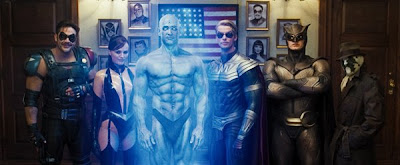


But the film belongs to Jackie Earle Haley, whose performance as the psychotic and vigilant Rorschach, is the strongest of the bunch. Rorschach's dialogue is potentially quite jarring (he speaks in a kind of diary-esque shorthand) but Haley's slow, gravelly voice lets it flow naturally through the narrative, delivering some of the best lines in the movie with a vein-popping intensity that chills you to your core. Billy Crudup also does well as the apathetic Doctor Manhattan, but his big realisation about the miracle of life falls a little flat. It's not particularly well explained and Crudups's almost dead-pan acting (which works well in other scenes, just not here) doesn't invest much emotion in the audience. Also, the CGI used on his glowing blue face is somewhat disappointing; as someone said to me, "I just with they'd given as much attention to his face as they did to his penis" (he spends most of the film naked). Having said that, the laboratory accident (which left him with his abilities) and subsequent restructuring of his body are visually fairly impressive.

For anyone worried that it could just be two and a half hours of "300"-style super slow motion, rest assured, it is (to some extent) kept to a minimum. Snyder obviously throws in some trademark slowmo to emphasise some of the more important moments, but it doesn't feel overused. The best example is in the explosive opening credits that take you through the events preceding the film, from the original Watchmen lineup in the 40s, apprehending bad guys; to a series of pop culture references and figures like Bowie and Warhol; to important political moments like JFK's assassination (in which The Comedian is perched on the grassy knoll); to the "present day" pseudo-1985 where masked vigilantes have been outlawed and the most recent team of watchmen are no more. The super slowmo creates a resounding poignance, complimented by the perfectly chosen "The Times They Are A Changing" by Bob Dylan, which is played over the whole sequence.

The entire soundtrack, in fact (with the exception of "Hallelujah" over the sex scene - terrible decision), is a strength. The period-appropriate pop songs are carefully selected and are touching in a kind of of-the-moment way that adds to the sense of that diverted history - highlights include Simon and Garfunkel's "The Sound Of Silence" at The Comedians's funeral, and the Hendrix version of "All Along The Watchtower" during the climax in Antarctica.
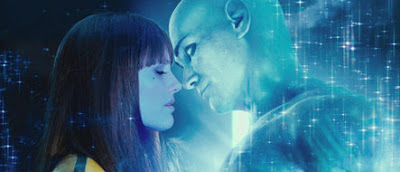

I think the film's downfall is probably its unavoidable dependance on the novel. It's packed with complex thematics and layers within the plot - as well as raising a lot of questions about religion, politics, and the superhero genre - the full extent of which is difficult to grasp in just one watch. Much of the dense layering, satire, and irony of "Watchmen" is lost on anybody who doesn't have some kind of background knowledge regarding the novel and its significance to comic book culture. Unless you know that the book was written 20 years ago and was absolutely the first of it's kind, some of the themes and relationships can appear unoriginal. Unless you've been made aware of the assumptions that Moore was trying to challenge at that time, and the importance of sex and violence in challenging those assumptions, the graphic nature of the film can come across as base, cheap entertainment, or an exciting filler to keep the audience interested. This puts the film at risk of bad reception, and makes it easy for an audience to completely miss the point. Perhaps it has missed its opportunity, and, 20 years after the book was written, the message has lost its resonance, creating difficulty for the audience in recognising its depth.

All in all, while to some extent it may struggle to stand alone as a film, away from the novel, in my eyes, "Watchmen" is a triumph. It is a stark depiction of the brutal, sociopathic violence of a group of unavoidably flawed individuals, and a thought-provoking consideration of the consequence and dilemma of power. It's bloody (but necessarily so), it's sexy, and it's masterfully stylish. Trust me, it's Awesome.

Oh, and get tickets for an imax showing, even if just for those opening credits. But don't turn up late or you'll be put in the front row. That's rubbish.